
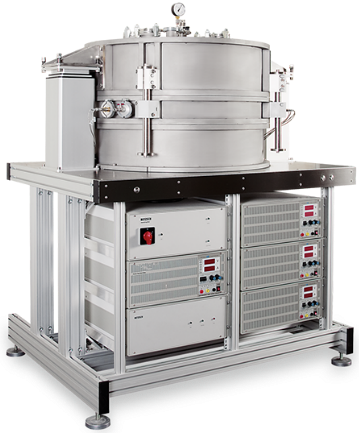
Brief description:1. Guarded Hot Plate Method (GHP) The guarded hot plate method, used as an absolute or reference method for testing a material's thermal conductivity, is currently recognized as the most accurate method. It can be used to calibrate standard samples or heat flux meters. Typically, a double-specimen guarded plate setup is used, where two identical specimens are symmetrically placed on either side of a central heating plate to measure the material's thermal conductivity. The central heating plate provides a constant heat source and comes with guard plates to maintain consistent heat flow, minimizing edge losses as much as possible.


Detailed
1. Guarded Hot Plate Method (GHP)
The Guarded Hot Plate method, used as an absolute or reference method for testing a material's thermal conductivity, is currently recognized as the most accurate method. It can be used to calibrate reference samples or heat flux meters. Typically, it uses a double-specimen guarded plate setup, where two identical specimens are placed symmetrically on either side of a central heating plate to measure the material's thermal conductivity. The central heating plate provides a constant heat source and is equipped with guard plates to keep the heat flow uniform, minimizing edge losses and ensuring the heat flows evenly through the center of the specimens. On the outer sides of each specimen, cooling plates are installed to create the desired temperature gradient. Once the system reaches steady-state equilibrium, the thermal conductivity is calculated based on the heating power of the plates and the temperature difference. This design reduces uncertainties compared to single-specimen testing.
The Guarded Hot Plate method is suitable for testing thicker or homogeneous low-conductivity materials, with thermal conductivity values ranging from 0 to 2 W/(m·K). Its advantages include high accuracy and good repeatability. Since experiments are conducted in a controlled environment, environmental variables can be tightly regulated, effectively avoiding heat losses, resulting in minimal experimental errors. High-temperature testing is also possible. However, there are also clear drawbacks, such as long testing cycles, high equipment costs, and relatively strict requirements on sample size.


2. Heat Flow Meter Method (HFM) & Guarded Heat Flow Meter Method (GHFM)
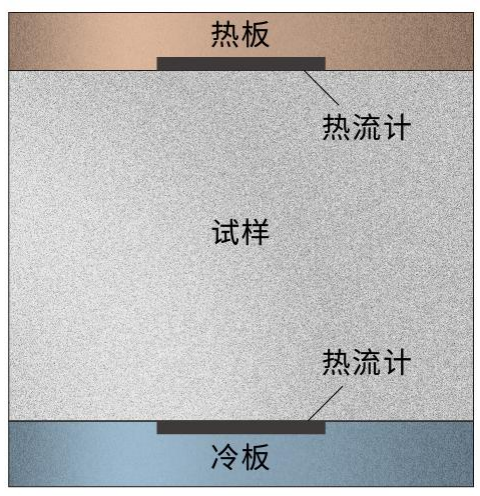
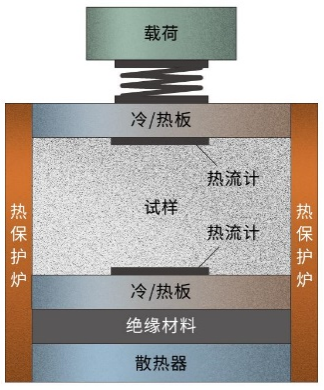
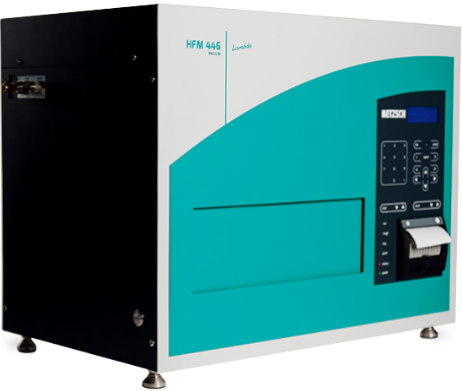
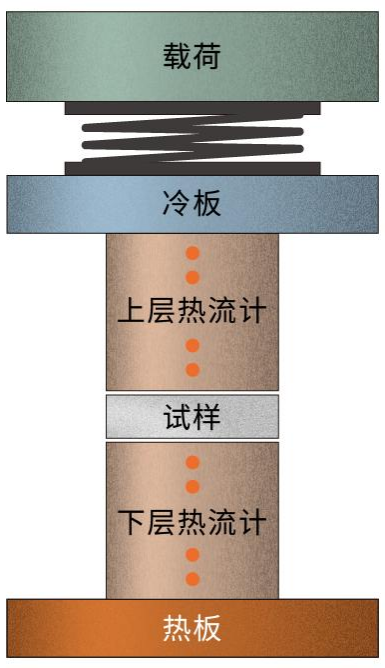
The principle of the heat flow meter method is similar to the guarded hot plate method. Specifically, the sample is placed between two plates, which maintain a certain temperature difference. The heat flow passing through the sample is measured using a calibrated heat flux sensor. Once thermal equilibrium is reached, the final data is collected, measuring only the central area of the sample. When testing samples with higher thermal conductivity, like glass, ceramics, and some metals, the sample has lower thermal resistance and increased lateral heat loss. In this case, the sample and the hot/cold plates need thermal guards during testing. This improved version of the heat flow meter method is called the guarded heat flow meter method.
The heat flow meter method is suited for testing insulating materials, with thermal conductivity measurements ranging from 0.001 to 2 W/(m·K). For medium and low-temperature tests, heat loss on both sides is minimal, making it a good alternative to the guarded hot plate method.
The guarded heat flow meter method works for samples with thermal conductivity between 0.1 and 40 W/(m·K), thermal resistance in the range of 10–400 ×10^-4 m²·K/W, and a diameter of about 50 mm. The temperature difference between the top and bottom of the sample is around 5–10°C, allowing simulation of thermal conductivity tests under different applied pressures.
3. Heat Flow Method (HF)
The heat flow method is a comparative method. It uses calibrated heat flux sensors to measure the heat flow through a sample, giving the absolute value of the thermal conductivity. During the measurement, a sample of uniform thickness is placed between two plates, and a certain temperature gradient is set. The calibrated heat flux sensor, which is in contact with both the plate and the sample, measures the heat flow passing through the sample. By measuring the thickness of the sample, the temperature gradient between the upper and lower plates, and the heat flow through the sample, you can calculate the sample's thermal conductivity.
The heat flow method is widely used to evaluate thermal management materials for electronic devices. It is suitable for testing the equivalent thermal conductivity and thermal impedance of both homogeneous and non-homogeneous electrically insulating thermal interface materials. It accommodates materials of different thicknesses and allows measurements under various temperature and pressure conditions, making it possible to simulate real-world applications.
Product inquiry