
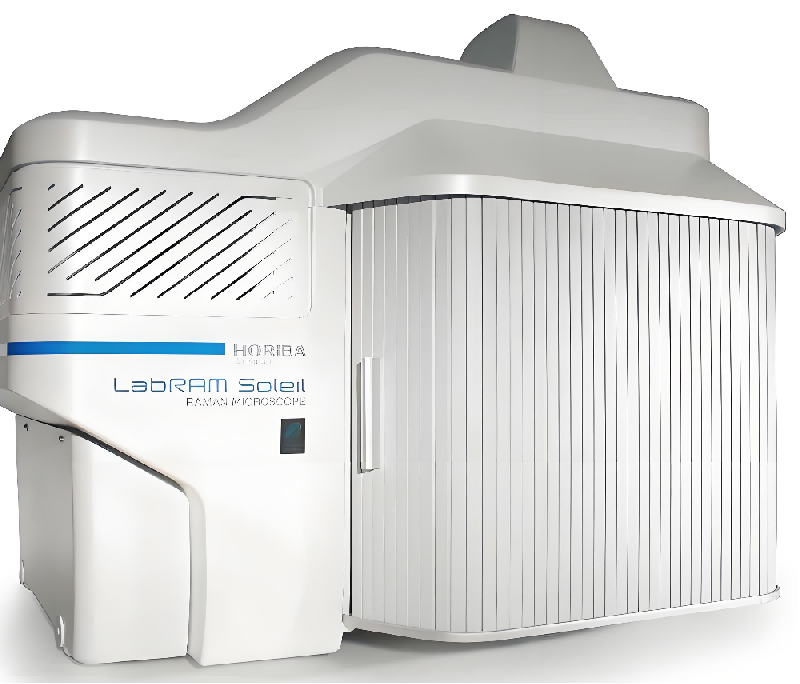
Brief description:The principle of a Raman spectrometer is very simple. When light hits a sample, the molecules in the sample cause the incident light to scatter. Most of the scattered light doesn’t change in frequency, and this type of scattering is called Rayleigh scattering. Some of the scattered light changes in frequency, which is called Raman scattering. The frequency difference between the scattered light and the incident light is called the Raman shift. A Raman spectrometer mainly uses the Raman shift to determine the molecular structure of a substance, and it can be used for solids, liquids, gases, organics, polymers, and so on.
Industry Applications:Qualitative and quantitative analysis, molecular structure analysis.

Detailed
The principle of a Raman spectrometer is pretty simple. When light hits a sample, the molecules in the sample scatter the incoming light. Most of the scattered light doesn’t change in frequency, and this kind of scattering is called Rayleigh scattering. Some of the scattered light does change in frequency, which is called Raman scattering. The frequency difference between the scattered light and the incoming light is called the Raman shift. Raman spectrometers mainly use the Raman shift to identify the molecular structure of a substance, and they can perform both quantitative and qualitative analysis on solids, liquids, gases, organics, polymers, and more.
Product inquiry